

data-title=”Agribusiness from Zhytomyr region stores grain in “yurts” for the fourth year”>Agribusiness from Zhytomyr region stores grain in “yurts” for the fourth year August 25, 2026 4217 0Yulia Nemtseva
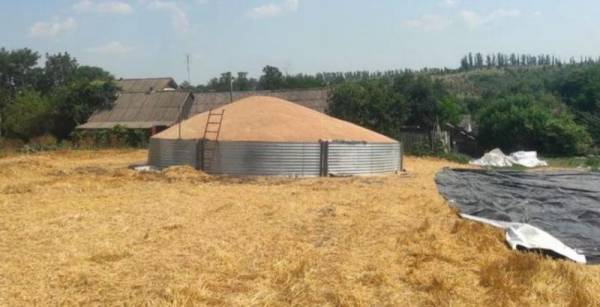
Modular grain storage
With the onset of the full-scale war, Ukrainian agricultural producers faced a significant deficit in grain storage capacity. In their search for solutions, they turned their attention to temporary grain storage facilities. This is reported by Elevatorist.com.
“In Ukraine, temporary grain storage has become particularly relevant due to unpredictable export logistics. They allow maintaining harvesting rates, avoiding forced sales of grain at low prices, and postponing investments in permanent infrastructure. For many agricultural enterprises, such storages are viewed not as an alternative to metal silos, but as a flexible component of a modern grain storage strategy,” explained Andriy Semenovych, director and co-owner of the company “Zernovyi Dim” (Sukup).
At STOV “Mlynyshche” from the Zhytomyr region, various methods of grain storage are employed. The enterprise has its own elevator and warehouses with a total capacity of 15 thousand tons of grain, and also utilizes polymer sleeves and modular containers. The latter are referred to as “yurts” due to their conical design. As stated by manager Yuriy Dmitriev, this technology has been practiced for four years now.
“We store all the crops we grow in the ‘yurts’ – soybeans, sunflowers, corn. For sunflowers, one storage unit holds approximately 350 tons; for soybeans and corn, it’s more – 550-600 tons. It depends on how it’s loaded,” the farmer explained.
According to him, they keep the grain in modular storages for 3-4 months after harvesting. If it’s corn, it can remain in the “yurt” from October to January-February.
At “Mlynyshche,” the containers are placed on an asphalt surface.
“I appreciate that we can access the grain from the container on the asphalt pad at any time. Because if you consider, for example, polymer bags that we load directly in the field, there’s an issue: if it starts raining, you can no longer transport the grain from there,” Yuriy Dmitriev clarified.
After the season concludes, the storage facility can be dismantled and stored compactly until its next use.
The cost of a grain storage unit is approximately from 6 to 12 dollars per 1 m³ of capacity. According to “Mlynyshche’s” calculations, the modular storages installed here paid for themselves in about two seasons. Now, the agribusiness intends to increase their number.
“They have met our expectations, so we plan to install four to five more modular storages this year. Firstly, it’s affordable. At the time we purchased them, we calculated that a ‘yurt’ pays for itself in about two seasons. It’s also important for us that it can be installed on virtually any site, and at any moment, one can drive up, open it, and retrieve the grain,” explained Yuriy Dmitriev.
Modular grain storages allow for quickly addressing capacity shortages and provide the agribusiness with greater flexibility in managing harvests. In the long term, they function best as a supplement to stationary infrastructure.

A Telegram channel for farmers who want to be one step ahead
Operational agricultural news, practical advice from the field, market analytics, and real farm cases

© Yulia Nemtseva, Kurkul.com, 2026.
#storage#cereals and legumes#Zhytomyr region
Джерело