
Actress Slava Krasovska: About playing goddesses, vertical series, and creating Kyiv’s scents
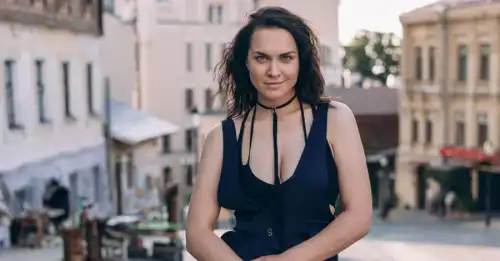
Photo: Provided by Slava Krasovska
This actress excels at everything: playing majestic dark goddesses and kind doctors, women seeking quiet happiness, and serfs fighting for a better fate. Slava Krasovska is a star of the series “Kreposna” and “Donky-Mati,” “Zhinocjyi Likar,” and “Oper za Vyklyk.” Recently, her filmography expanded with the role of a dark, sinister goddess in the teen fantasy “Khreschatyk 48/2,” which explores adventures in Kyiv’s afterlife.
Incidentally, Kyiv is a true source of inspiration for the actress. She has dedicated her author’s brand of Kyiv souvenirs, “Paniynka Kyivianka,” to her native city.
In an interview with Korotko Pro, Slava Krasovska shared her thoughts on how Andriyivskyy Descent and Yaroslaviv Val smell, what draws her to teaching, how she fares as witches and mystical deities, and where she learned professional stage combat.
Playing negative characters in fantasy stories is much more interesting than positive ones
– Slava, the Ukrainian fantasy film “Khreschatyk 48/2” was recently released in cinemas – it’s a cool fantasy story with quality humor. You played the ancient death goddess Mara in the film. Do you know why they chose you for this role?
– I think Oleksiy Komarovskyi (producer of the “Khreschatyk 48/2” project) liked my voice-over work in his previous film “When You Marry?”. He was looking for an actress to dub a negative character in English. He needed a deep voice, good pronunciation, and, of course, the ability to portray a true villain. Since Oleksiy was apparently already developing the idea for “Khreschatyk” during the post-production of the previous film, he invited me for an audition for the role of Mara shortly after our studio work.
– So, you have perfect English?
– I don’t consider it perfect, but I work in English for voice-overs and occasionally act in English-language productions. In Kyiv, there’s a production studio called Amo Pictures – they create English-language content for foreign clients. Previously, it was short films for YouTube or Facebook addressing important social issues concerning women’s rights, attitudes towards different social strata, and abuse. Now, they are heavily involved in vertical series. This format is popular in foreign markets, though it’s not yet well-developed here. However, in Kyiv, such content has been actively produced for several years, and quite beautifully and qualitatively. Importantly, they feature Ukrainian actors. We all speak English, and perhaps the people worldwide watching us don’t realize they are Ukrainian actors.
– Your death goddess is very sinister and wicked – are you not afraid to play such roles?
– I’m not afraid because, firstly, it’s a fairy tale, and there’s nothing truly terrifying about it. Every fairy tale needs evil to be ultimately punished and destroyed. Someone has to play these roles. Secondly, playing negative characters in fairy tales and fantasy stories is much more engaging than playing positive ones.
– Your death goddess is stylish and luxurious. It’s almost a shame that at the end of the film she’s sent into a mirror, like a prison. But something tells me that in the sequel to “Khreschatyk 48/2,” which will begin production soon, you will reappear in this role.
– I bear no responsibility for that. Whatever Oleksiy Komarovskyi and the scriptwriter Yuriy Mikulenko decide, so it will be. But I hope and believe that Mr. Yuriy will find a way to get me out of that mirror. I would really like that.
– You are a native Kyivian. I imagine it was important for you that “Khreschatyk 48/2” is dedicated to Kyiv. The capital is essentially the main character of this story.
– It’s important that films dedicated to Kyiv are appearing now, just as it’s important that filmmakers are no longer shy about naming Kyiv in their work. In the past, when the Moscow trend dominated film production, it was necessary to create films and series that would sell across the entire so-called CIS. In those series, even if famous Kyiv locations appeared, Kyiv itself couldn’t be directly mentioned. The script would always feature only words like “capital,” “city,” “town” – anything but geographical names. This was done to make it seem like the setting could be Minsk, Astana, or who knows what.
Now, we can openly name Kyiv in films, dedicate plots to it, as the creators of “Khreschatyk 48/2” have done, and incorporate Ukrainian folklore and mythical characters into the story. The main thing is that this process develops and resonates with the audience because it’s incredibly interesting and remains an untapped field in our cultural industry.


At the premiere of ‘Khreschatyk 48/2’ with producer Oleksiy Komarovskyi, Hryhoriy and Khrystyna Reshetnyk, and their sons. Photo: Provided by Slava Krasovska
If fire shot from my hands in real life, I’d end up in a psychiatric hospital
– Speaking of magic, your characters in films often possess it – in the series “Chaklunky,” you play an ordinary girl who accidentally gains magical abilities. What would you do in real life if you had such powers?
– You know, it’s fun to fantasize about, but honestly, if fire shot from my hands in real life, I’d probably end up in a psychiatric hospital (laughs). It’s hard to comprehend such magic appearing in reality. Frankly, I wouldn’t want to transfer any fairy-tale abilities into real life. But if we’re playing and imagining, out of all possible superpowers, I’d love to master teleportation to quickly appear elsewhere and not worry about parking. Also, like in the series “Charmed,” I’d want to learn to stop time to have more of it. You could freeze the world around you, finish all your chores, like washing dishes, and then “unfreeze” time and do something important for the world.
– You see, we’re talking about witches again. Has anyone ever told you that you have a dark charm? What’s your archetype in life?
– I don’t think people have archetypes in life. There’s this modern concept of a personal brand, and experts categorize people into archetypes. But, honestly, I don’t want to be tied to any single archetype or image because, perhaps due to my profession, or maybe my personality, I don’t feel confined to one type. I might have a period or mood where I want to be gentle, feminine, and wear dresses. Or I might have a period where I absolutely don’t care how I look or if anyone likes me. So, I really wouldn’t want to get stuck in one specific role.
– And what about your roles in theatre?
– Obviously, due to my low voice, and quite tall stature and build, I’m most often cast in films for roles of strong, warrior women, leaders, military personnel, various bosses, and directors. This is perfectly logical, as these are roles that suit my physical appearance. In theatre, however, I have the opportunity to embody completely different characters – like the almost despondent Mrs. Mueller in the play “Doubt,” or the wife of Zbruzhek, intimidated by a tyrannical husband, in the play “Maklena Grasa.”


Slava Krasovska in the play ‘Doubt’ directed by Yuriy Kulinich. Photo: Provided by Slava Krasovska
– Regarding your film roles, judging by your filmography, you have quite a few. What can we expect in the near future?
– I recently auditioned for a feature film – I don’t know yet how it will turn out or if this project will proceed with my involvement, but it has a very interesting plot. It’s a feature film commissioned by Derzhkino. I really liked the concept of the script; I would be very interested in working on this picture. And I’m awaiting news about the film “Lyutyy Pryvit,” as we finished filming it last autumn, but for some reason, information about it has disappeared from the radar. I don’t know the reason for the delay, but I hope the film will be released because it tells a very poignant and, I believe, a necessary story for today. And it features a very good director, Maksym Lytvynov, who usually directs heartfelt stories.
– Regarding theatre, you perform at the small but notable Malyi Theater. Why there? It seems to me you would be welcomed with open arms at any national theatre.
– I was never welcomed with open arms at any national theatre. After obtaining my bachelor’s degree, our entire class went for auditions at various theaters – we visited “Lėsė,” TYUZ, Molodyi… many places. And I wasn’t hired anywhere then. I went into my fifth year, continued my studies, and acted in productions at the student theater at Karpenko. After the fifth year, I was very fortunate to quickly and easily break into the film industry – immediately after graduating from university, I landed a major linear role in the series “Zhinocjyi Likar.” I spent six months on set – I had about a hundred shooting days there. Around the same time, I started teaching acting to children.
Honestly, I have no complexes about not performing in a national theater. I’ve always had plenty of interesting work and was creatively fulfilled, so I never worried about not playing the third cousin of Juliet on the right side of the stage at some national theater. But after those casting calls, several years passed, and it so happened that I became part of the wonderful Malyi Theater.
– What makes Malyi Theater special? I’m talking about the vibe of your theater.
– I think, first and foremost, the value of the historical building of our theater, its location (33 Honchara St. – Auth.), plays a significant role. And for me personally, it’s important that it’s a chamber theater, where you always perform on stage as if in close-up. The audience is very close to the actors here, and you have no chance to falter or lie because everything is very visible. It’s also important that we don’t have a resident staff of directors; the plays are always staged by special individuals who come to the theater for genuine reasons.
For my last two performances, I was incredibly lucky because our actor Yuriy Kulinich (“best actor of the year” at two national film awards for the film “Bad Roads” (2021) – Auth.) served as the director. Yura has a second degree in directing, and he staged two wonderful plays at our theater: “Doubt” and “The Lesson.” I really appreciate his approach, courage, and aesthetic. And in this specific combination, where a director comes to the theater not just to collect a fee but genuinely wants to realize their idea, it’s very important and highly effective.
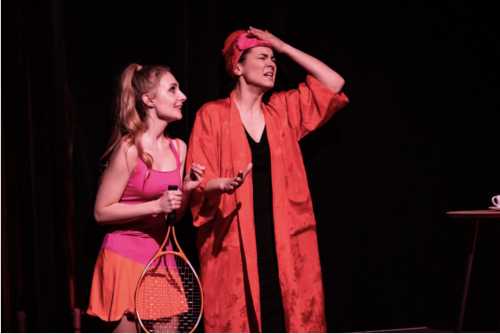

A scene from the play ‘Maklena Grasa’ at the Malyi Theater (dir. Dmytro Veselskyi). Photo: Provided by Slava Krasovska
I played a goddess with huge wings and flew through the air on wires
– Regarding acting skills, I know you have a diploma from the British Academy of Stage Combat. Does that mean you know how to fight beautifully on stage?
– To be able to perform stage combat and stunts, one needs constant practice and skill maintenance, which I don’t do. So, I can’t say I’m proficient, but I have the foundation, and it interests me. I believe an actor should develop supplementary skills such as horseback riding, stage combat, playing musical instruments, etc. That is, to develop in all directions that can be utilized in various roles.
As for the courses, I was fortunate because an actor acquaintance brought British Academy instructors to Ukraine in 2018. We initially had a course on stage hand-to-hand combat. This isn’t martial arts; it’s stage combat, focusing on safety, safe distance, and correct angles. We were taught how to make it look like you’re hitting someone without harming your partner and how they can convincingly act as if they’ve been hit, while the camera doesn’t capture the gap between the fist and the nose. It always involves safe distances, safe techniques, and angles where the camera can be deceived to create the illusion of contact.
In the second course, we were taught how to fight with knives and swords. That’s also very interesting, but again, I have the basics and a certain understanding of stage combat. However, to stage a good fight scene for a film, I would still need to spend a week in the gym for stunt performers to choreograph it and for me to practice everything, because without constant practice, it doesn’t stay ingrained in the body.
– But still, you can swing a sword, right? I can totally picture you as a warrior in some cool fantasy, like a warrior princess.
– I can swing a sword beautifully, why not (smiles). I was in a film, a short one, which unfortunately never got released. We had a very beautiful sword fight scene there. I played a goddess, I forget her name, and I flew through the air. My goddess had huge wings, and they lifted me on stunt wires so I could land with a sword in front of my enemies.


The film where Slava played a goddess with wings, unfortunately, was never released. Photo: Provided by Slava Krasovska
– You mentioned that you started teaching acting to children. I found your group, ARTISTIC, on social media – an acting workshop that functions as a full-fledged children’s theater. How difficult is it to teach acting to children? You constantly need to surprise them with something.
– Absolutely, it’s difficult because I cover most of the needs of our group myself: I come up with concepts, write scripts, as my group is entirely female – we haven’t had boys for several years. So, first and foremost, I have to find material suitable for an all-female team. This year, I created a performance based on stories about remarkable women from different eras. We have Audrey Hepburn, Frida Kahlo, Lesya Ukrainka, and Marie Curie – completely diverse female figures sharing their stories.
Besides the script, I have to devise the visual design from scratch, select music, and create costumes and props. Fortunately, I now have a second instructor – one of my former students – whom I can rely on during rehearsals. But I only have one assistant, and this season we had sixteen actresses. And, of course, it’s a great responsibility and a significant workload because I want to give them as much as possible. We perform plays in Kyiv, then travel to festivals. Naturally, it’s all challenging, but it’s worth it because I see how much the girls enjoy it. I see how they light up with creativity, and I’m proud of my graduates who go on to pursue acting.
– Has any of your graduates become a professional actor?
– My graduate, Marychka Khomenko. In January, I attended the premiere of a film she starred in – “Ispytatelnyj Termyn,” and then I watched her in the play “Zemlya” at the Lesya Ukrainka Theater, directed by Ivan Uryvskyi. And I’m very pleased that such a popular director now noticed Marychka among all the students at a showcase and invited her to his play. And this inspires me to continue investing in my teenagers. Marychka is very talented; from the very beginning, I knew this child absolutely had to continue acting. And for those like her, I’ve been teaching for over ten years. Every year, new members join our group; currently, ARTISTIC has eleven participants.
– What does this work with teenagers personally give you? After all, you could spend all this time on yourself, on your roles.
– Firstly, I’m very good at it, and I realized a long time ago that I can’t deprive the world of such a wonderful teacher if I’m so skilled at it. We will resume our activities in September and invite you to new performances by the ARTISTIC collective.


With the ARTISTIC collective at the theater festival The fest the best in Vinnytsia. Photo: Provided by Slava Krasovska
I conducted a focus group on what Andriyivskyy Descent should smell like
– I can’t stop being amazed by you. You are an actress and a teacher, and recently I learned that you are the creator of the Kyiv souvenir brand “Paniynka Kyivianka,” you create these souvenirs yourself, and dedicate them to Kyiv. Where did this idea come from?
– A long time ago, a friend told me that in life, you should do what you yourself lack. And this thought stuck with me – I thought that when I lack “proper” souvenirs to bring back as gifts from Kyiv, I should create them. It was important that they be small in size, suitable for anyone, and carry the true Kyiv vibe.
And since I immensely love my city, as a dedication to it, I decided to develop a line of unique souvenirs in the form of shoppers, scented candles, and handmade aromatic soaps, where each scent is dedicated to a famous Kyiv location.
By the way, I make the soaps myself and choose the scents very carefully. Therefore, the soap “Kino v ‘Zhovtni'” smells like caramel popcorn; “Pobachennia v Parku,” dedicated to Kyoto Park, smells of cherry blossoms; “Ranokovyi Yarval” surprises with the spicy aroma of cinnamon – this beautiful street is associated with it for me. Currently, I have 13 scents, and the fourteenth will appear only at Christmas. But when the soap “Andriyivskyy Descent” is released, there will be 14 official scents.


‘Paniynka Kyivianka’ is about the actress’s love for Kyiv. Photo: Provided by Slava Krasovska
– And what does “Andriyivskyy Descent” smell like?
– I haven’t decided on the scent yet, but I’ve already conducted a focus group on what “Andriyivskyy Descent” should smell like – everyone has very different associations. And perhaps, for Halloween, I’ll present the soap “Misticheskyi Kyiv.” I have many more ideas on how to further develop the “Paniynka Kyivianka” products – it lives and boils within me. But the main thing is to feel that someone is interested. Because I’ve noticed that many people look at the products but don’t really understand what’s depicted, what it’s dedicated to, or why it’s needed.
I’ll tell you more, people sometimes confuse the “Zhovten” cinema with the Palace “Zhovtnevyi.” Once, while showing my products at a market, I told a lady, “Here’s the soap called ‘Kino v ‘Zhovtni’ – it smells like caramel popcorn.” And she sadly replied, “It’s just that there’s no popcorn there.” At first, I thought she had smelled the soap and couldn’t detect the popcorn aroma, but she explained that there’s no popcorn in the Palace “Zhovtnevyi.” And then it dawned on me that the lady, neither from the picture nor the name, understood that the “Zhovten” cinema on Podil was meant.
– You see, you’ve made a discovery for her. So, from your side, it’s also an educational activity. And what does being a Kyivian mean to you?
– Honestly, I don’t know how to be anyone else. When I was about seven years old, I realized that, surprisingly, people live in other cities too, and they also have schools, for example. I was very surprised then that the world was much larger than I had imagined. But I can’t compare it to anything because I don’t know what it’s like to live somewhere else. And it’s a blessing that I don’t know, because I feel I couldn’t endure living in another city or country for a long time. And it’s a blessing that I don’t have the experience of emigration.
– How much has Kyiv changed during the war? What concerns you, and what brings you joy in this city? Although there’s little to rejoice about now, our city is very sad at the moment.
– It is sad, but there is a lot of support within it. In English, there’s an idiom: “every cloud has its silver lining.” This little silver lining is the support among citizens that arises during difficult times. And this happens constantly during the war. For example, my neighbor tells me, “If it’s difficult for you to go to the shelter with both dogs, bring one, I’ll stay with it, keep an eye on it, and you can look after the other.”
Now, people are developing a more humane attitude towards strangers or acquaintances than is often the case in a large city. Because usually, we all keep our distance from each other, maybe we don’t even know our neighbors’ names. But when trouble strikes, we have to unite, help, and support both our own and strangers – everyone.
I will never forget that human chain of people passing water in bottles across four lanes of Bere Ukrainian Avenue when rockets hit “Okhmatdyt.” It was incredible. And this speaks to the ability of Ukrainians to unite in difficult times.


When Slava isn’t acting, she creates souvenirs for ‘Paniynka Kyivianka’. Photo: Provided by Slava Krasovska