

“>
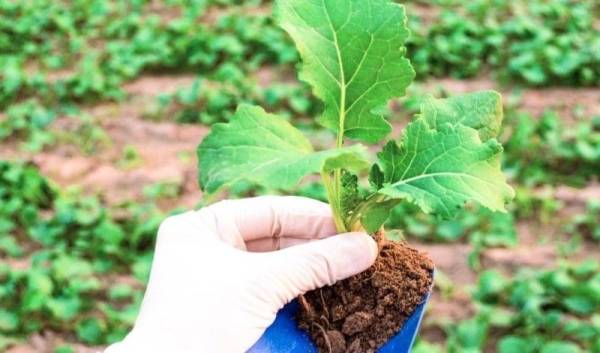
Photo: Ukravit
Traditionally, winter rapeseed is sown quite early, so its growth and development in autumn are prolonged, lasting 45-60 days. During this time, the crop must form a leaf rosette of 6-8 leaves, a well-developed taproot system (15-20 cm), and a root collar with a diameter of 8-12 mm. It is important for the leaf rosette to be pressed close to the soil surface, and the height of the growing point above the soil surface should not exceed 2 cm. Such architecture is a prerequisite for successful overwintering and high, stable yields.
Easily digestible phosphorus plays a significant role in these processes. After all, in autumn, rapeseed removes 20 to 40 kg of P2O5 per hectare. And from germination to the autumn rosette, the crop consumes at least 15%, and sometimes up to 30% of phosphorus of its total requirement.
What other mineral nutrition elements are critically important in autumn and at which phenological stages does the crop need them most, as explained by specialists from Ukravit company.
“Even if the soils contain high total phosphorus reserves, there is always a shortage of water-soluble phosphorus. According to scientific sources, 1 hectare may contain from 600 g to 1500 g of water-soluble phosphorus, depending on the soil type, which is very little. That is why the application of liquid complex fertilizers containing water-soluble phosphorus into the seedbed during sowing is becoming increasingly important. Phosphorus applied in this way ensures active growth and development of the root system, especially lateral root hairs, which absorb nutrients and water. This promotes good development of the taproot system, especially the root collar, leads to cell differentiation and carbohydrate accumulation, and forms an optimal ratio between vegetative organs and the root system, meaning the growing point does not extend above the soil surface by more than 2 cm. At the same time, in autumn, the crop’s reproductive organs are formed. Thus, at the 4-6 leaf stage, lateral stems are initiated, and from the 8-leaf stage onwards, inflorescences on the main stem are formed, and nutrients are stored in the root system to resume spring vegetation. It is critically important to provide the crop with complete mineral nutrition at this phenological stage – not only phosphorus or potassium, but also sulfur compounds, boron, manganese, and possibly even growth stimulants to activate the absorption of mineral nutrients,” notes Serhiy Adamenko, Head of the Product Development and Microfertilizer Services Department at Ukravit.
For effective starter nutrition, Serhiy Adamenko recommends the liquid complex fertilizers Avangard NPK of three grades: 5-20-5 (5% nitrogen, 20% phosphorus, and 5% potassium), NP 8-24 (8% nitrogen, 24% phosphorus calculated as P2O5), and a more concentrated grade – NPK 3-18-18 (3% nitrogen, 18% phosphorus, 18% potassium calculated as K2O). They are made from high-quality raw materials, have a low salt index of 14-16.5%, are highly technological in application, and can be applied directly into the seedbed using IN-FURROW and POP UP technologies, or alongside the seed (2 cm below and 2 cm to the side, or 5 cm x 5 cm).
In addition, for developed crops on chernozem soils from the 4-leaf stage, the specialist advises foliar feeding of winter rapeseed with Avangard Complex Rapeseed microfertilizers at a rate of 1.5-2.0 l/ha and Avangard Boron at 1.0 l/ha. This combination meets the crop’s needs for easily digestible boron and other mineral nutrients and promotes overall growth and development.
On alkaline soils and soils deficient in manganese, Serhiy recommends adding Avangard Manganese at a rate of 1.0 l/ha to this composition. Manganese influences photosynthesis, nitrogen uptake, and most importantly, the synthesis and accumulation of sugars necessary for overwintering.
On acidic soils with insufficient molybdenum supply, it is advisable to use Avangard Molybdenum at a rate of 0.5-1.0 l/ha along with Avangard Complex Rapeseed and Avangard Boron fertilizers. Molybdenum promotes nitrogen uptake, activates over 20 enzymes, is part of the nitrate reductase and nitrogenase enzymes, and supports photosynthetic processes.
For later sowing dates, from the 4-leaf stage onwards, it is recommended to apply Avangard Complex Rapeseed, 1.5-2.0 l/ha, in combination with Avangard Phosphite K or Avangard Phosphite K + micro fertilizers at a rate of 1.0 l/ha. Phosphite fertilizers stimulate the absorption of mineral nutrients and exhibit a fungicidal effect against diseases caused by downy mildew fungus.
All About Crop Nutrition

Olena Basanets, SuperAgronom.com
Be the first to get the latest agronomic news from Ukraine on our Facebook, Telegram pages, and subscribe to SuperAgronom’s Instagram.